

/en/
[row class="c-rcktcms__center"]
[col size="12"]
Scoville Scale: measuring chili pepper heat in SHU
The Scoville scale is the reference system that measures the heat of a chili pepper and a hot sauce. Created in 1912 by pharmacist Wilbur Scoville, it classifies chili peppers according to their capsaicin content, the molecule responsible for the burning sensation on the taste buds. From the sweet bell pepper at 0 SHU to the world's hottest pepper, this guide explains where this scale comes from, how it works, how to read it, and how to use it to season your dishes without burning yourself.
Key points at a glance:
- The Scoville scale measures heat in SHU (Scoville Heat Units), from the bell pepper at 0 SHU to Pepper X at nearly 2.7 million SHU.
- It was created in 1912 by American pharmacist Wilbur Scoville.
- The more capsaicin a chili pepper contains, the higher its SHU value.
- Measurement is now done by liquid chromatography, which is more precise than the original tasting test.
What is the Scoville scale?
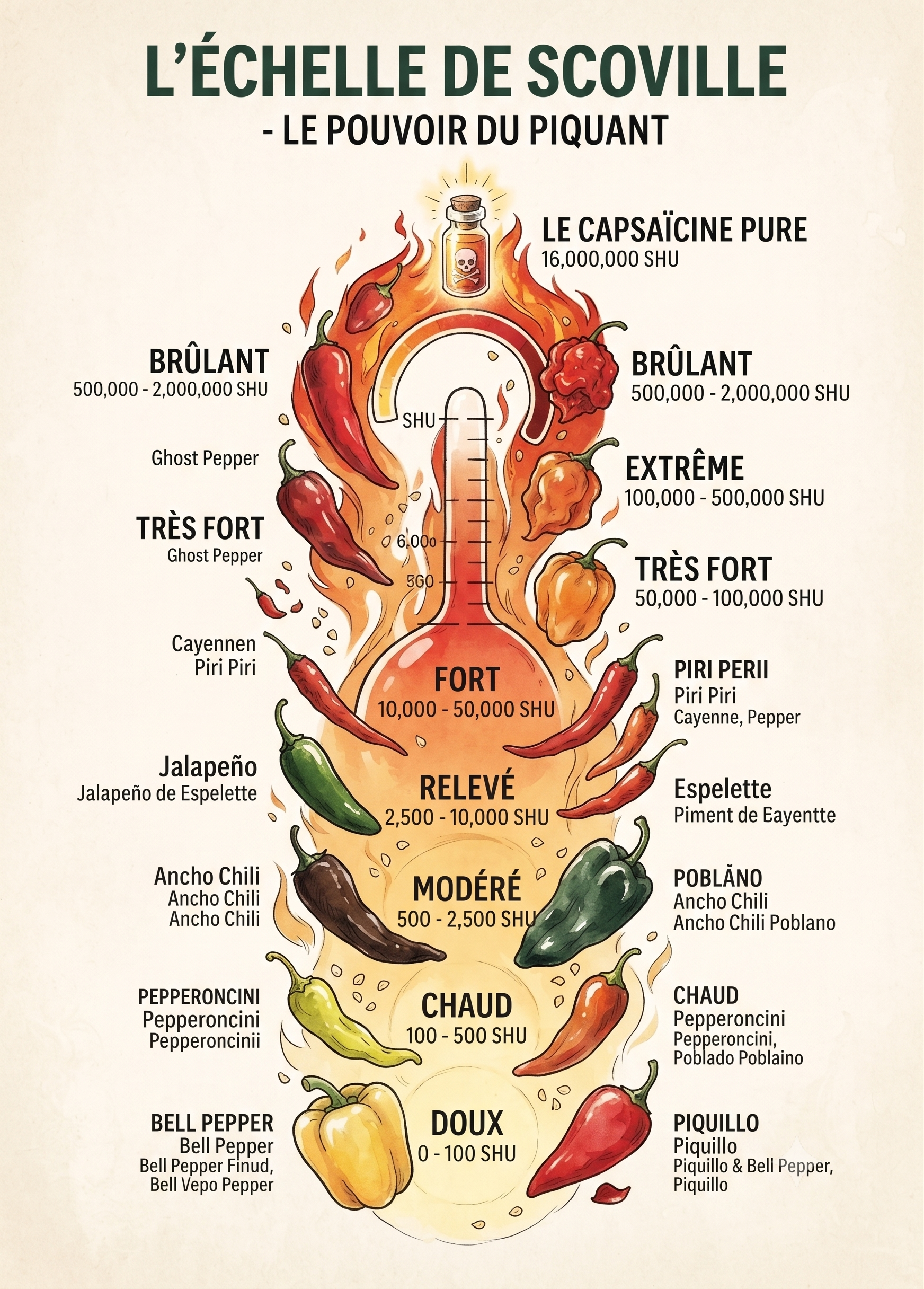
The Scoville scale, also known as the "Scoville Heat Scale," expresses heat intensity in SHU (Scoville Heat Units). The principle is to progressively dilute a chili pepper extract in sugar water until the heat is no longer perceptible: the greater the dilution required, the hotter the pepper. A pepper rated at 5,000 SHU must therefore be diluted 5,000 times for the burning sensation to disappear.
This unit of measurement applies to all forms of the fruit: fresh red chili pepper, dried chili pepper, chili powder, crushed flakes, or hot sauce. It is now the universal reference for positioning a spicy condiment, from the mildest sweet pepper to the most formidable hot chili, including medium-strength hot peppers like the green jalapeño.
Who invented the Scoville scale and why?
The scale bears the name of its creator, Wilbur Scoville, an American pharmacologist. In 1912, he developed the Scoville Organoleptic Test, a method based on tasting: a panel of tasters determines at what dilution the heat becomes imperceptible. More than a century later, this ranking scale remains the most intuitive reference, both for spice enthusiasts and the food industry.
How does the Scoville scale work?
The original method was sensory, and therefore subjective: five tasters sampled a solution of fresh chili peppers reduced to a purée and mixed with sugar water, and the dilution continued as long as the burning sensation persisted. Cayenne pepper, for example, must be diluted between 30,000 and 50,000 times before its heat completely fades from the mucous membranes.
Today, high-performance liquid chromatography (HPLC) is preferred, which directly measures capsaicin concentration and converts it into SHU. This technique is far more precise and reproducible than tasting, but the Scoville scale remains the most intuitive way to communicate heat levels to the general public.
What do SHU actually measure?
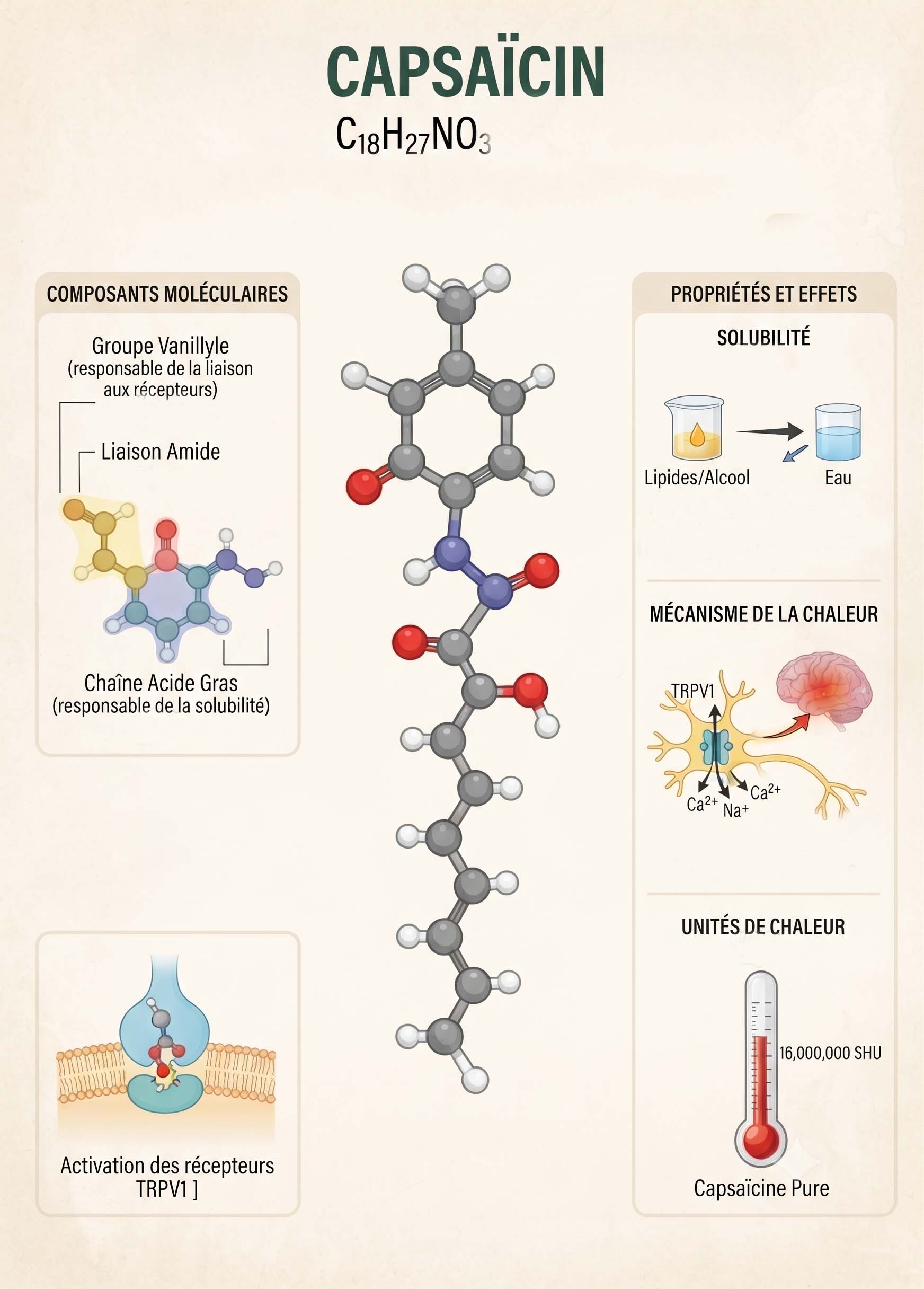
SHU quantify the amount of capsaicin, the compound from the capsaicinoid family that acts on the sensory receptors in the mouth. These receptors (TRPV1, normally responsible for detecting heat) are activated by the molecule and send a burning signal to the brain, even though no high temperature is involved. The higher the SHU value, the hotter the pepper. The brain reacts by releasing endorphins, which explains the exhilarating sensation sought by hot pepper enthusiasts.
How to read the Scoville scale: the reference table
To quickly get your bearings with a chili pepper, here is a stepped reference guide, from mildest to most explosive. It gives orders of magnitude: the actual heat of a fruit varies depending on its variety, ripeness, terroir, and drying method.
| Level | Rating | Scoville Units | Example pepper |
|---|---|---|---|
| 0 | Neutral | 0 – 100 | Red bell pepper |
| 1 | Mild | 100 – 500 | Sweet paprika |
| 2 | Warm | 500 – 1 000 | Anaheim Chili Pepper |
| 3 | Spicy | 1 000 – 1 500 | Ancho Chili Pepper |
| 4 | Hot | 1 500 – 2 500 | Espelette pepper |
| 5 | Strong | 2 500 – 5 000 | Chimayo pepper |
| 6 | Fiery | 5 000 – 15 000 | Cayenne pepper |
| 7 | Scorching | 15 000 – 30 000 | Cascabel Chili Pepper |
| 8 | Torrid | 30 000 – 50 000 | Piment de Arbol |
| 9 | Volcanic | 50 000 – 100 000 | Tabasco pepper |
| 10 | Explosive | + 100 000 | Caribbean Habanero pepper |
This table is just an overview. For variety-by-variety detail, from the mild Italian pepper to the world champion, check out our chili pepper ranking on the Scoville scale.
The hottest peppers on the Scoville scale
At the very top of the scale are the "super-hot" peppers, the result of many years of hybridization aimed at concentrating maximum capsaicin. Here are the figureheads of this extreme ranking, from the current record holder to the historic varieties:
- Pepper X has dominated since 2023, certified by Guinness World Records, with a heat level reaching up to 2.69 million SHU.
- The Carolina Reaper, former record holder created by Ed Currie, peaks at around 2.2 million SHU.
- The Trinidad Moruga Scorpion, originating from Trinidad and Tobago, ranges between 1.2 and 2 million SHU.
- The Naga Jolokia, or Ghost Pepper, grown in India, comes in at around 1 million SHU.
- The red Habanero, a classic and highly aromatic Caribbean pepper, ranges between 100,000 and 350,000 SHU.
At the absolute peak, pure capsaicin tops out at around 16 million SHU. No chili pepper variety will ever reach it, but this value sets the theoretical ceiling of the scale.
Where do chili peppers come from? Origin and botany
The chili pepper belongs to the genus Capsicum, of the nightshade family, like the tomato, eggplant, and potato. Native to South America and Central America, it was already cultivated by the Aztecs long before the arrival of Europeans. It was Christopher Columbus who brought the first chili seeds back to Europe at the end of the 15th century, believing he had found a new form of pepper, hence the English name "pepper" that has remained associated with these fruits.
From there, the chili pepper spread to cuisines around the world and took root in very diverse terroirs: the Basque Country with the famous Espelette pepper PDO, Mexico with its essential Mexican varieties, the Caribbean and its Creole cuisine, and Africa with the pili pili. Each region has shaped its own preparations, from spiced couscous and harissa to Basque piperade.
The health benefits of chili peppers
Beyond its place on the Scoville scale, the chili pepper is a fruit with genuine health benefits. It is exceptionally rich in vitamin C: a fresh red chili pepper contains significantly more than an orange of equal weight. It also contains vitamin E, antioxidants, and polyphenols that help neutralize free radicals responsible for oxidative stress.
Capsaicin itself is not just a source of burning. By stimulating thermogenesis, it slightly speeds up the metabolism and promotes a feeling of satiety, making it a valued ally in a balanced diet. Consumed in moderation, it also supports digestion and blood circulation. Like any spicy food, chili peppers should be dosed according to one's tolerance, but their nutritional qualities explain their reputation as a "healthy" spice.
What is the Scoville scale used for in cooking?
Knowing the SHU allows you to adjust the heat of a recipe without altering it. A jalapeño pepper (2,500 to 8,000 SHU) spices up a chili con carne, guacamole, or salad without overwhelming the palate, while a simple pinch of Habanero is enough to transform a marinade, a grilling seasoning, or a chili sauce. The scale thus helps you add a touch of chili to a meat dish, shrimp, beans, or soup while keeping control over the intensity.
The Scoville scale also serves as a safety guardrail. Beyond one million SHU, a chili pepper or sauce can cause severe irritation to the eyes, mouth, and stomach. It is best to wear gloves, dose very sparingly, and keep these products out of reach of children. In case of a burning sensation, milk, yogurt, or cheese soothe the burn far better than water, as capsaicin dissolves in fats.
Growing your own chili peppers
Mastering the Scoville scale often inspires people to grow their own chili peppers to precisely choose their heat level. Growing chili peppers starts with sowing in a warm spot in late winter: place the chili seeds in light potting soil, keep the moisture until germination, then transplant the young seedlings before planting them in the ground once all risk of frost has passed. The plants love warmth, regular watering, and well-drained soil.
At maturity, the fruits turn from green to bright red and gain in heat. They can then be harvested for fresh consumption, or dried to obtain chili powder, flakes, or whole chili peppers to store in an airtight jar. Drying concentrates the aromas and makes storage easier, whether in the refrigerator or at room temperature.
Advantages and limitations of the Scoville scale
On the plus side, the Scoville scale offers valuable standardization: it allows chili peppers to be classified objectively, its SHU values are easy to understand, and it remains an accessible and widely adopted reference in the culinary world.
Its limitations stem from its historical method. The original organoleptic assessment relied on human taste, which made results variable from one taster to another. Liquid chromatography has since brought the precision that was lacking, but it is not systematically used, particularly for artisanal or exotic sauces, whose values are often only estimated.
Going further on the subject of heat
You now know how to read the Scoville scale. To go further depending on your needs, two resources extend this guide, each with its own logic: to identify the heat level of a specific variety, the hot sauce ranking by heat level positions our products by intensity, while the chili pepper encyclopedia details the history, uses, and cultivation of each variety.
Choose your sauce according to your level on the Scoville scale
To move from theory to tasting, our sauces are classified by SHU levels, from the most accessible to the most extreme:
- Mild sauces: from 0 to 10,000 SHU, to start off gently.
- Medium sauces: from 10,000 to 40,000 SHU, the perfect balance of flavor and heat.
- Hot sauces: from 40,000 to 100,000 SHU, for seasoned palates.
- Extreme sauces: from 100,000 to over one million SHU, to be handled with care.
[/col]
[/row]